Fired Festival · Hackathon Recap
After Fired Festival
Sunday, June 14, 2026
1 year ago I'd never heard of Cursor.
2 weeks ago, I signed up for an AI hackathon.
3 days ago, I nearly gave up my spot, with imposter syndrome creeping in.
Today I'm back home, staring a bit in disbelief at the Mac Mini sitting on my desk, a first place prize for my time and efforts.
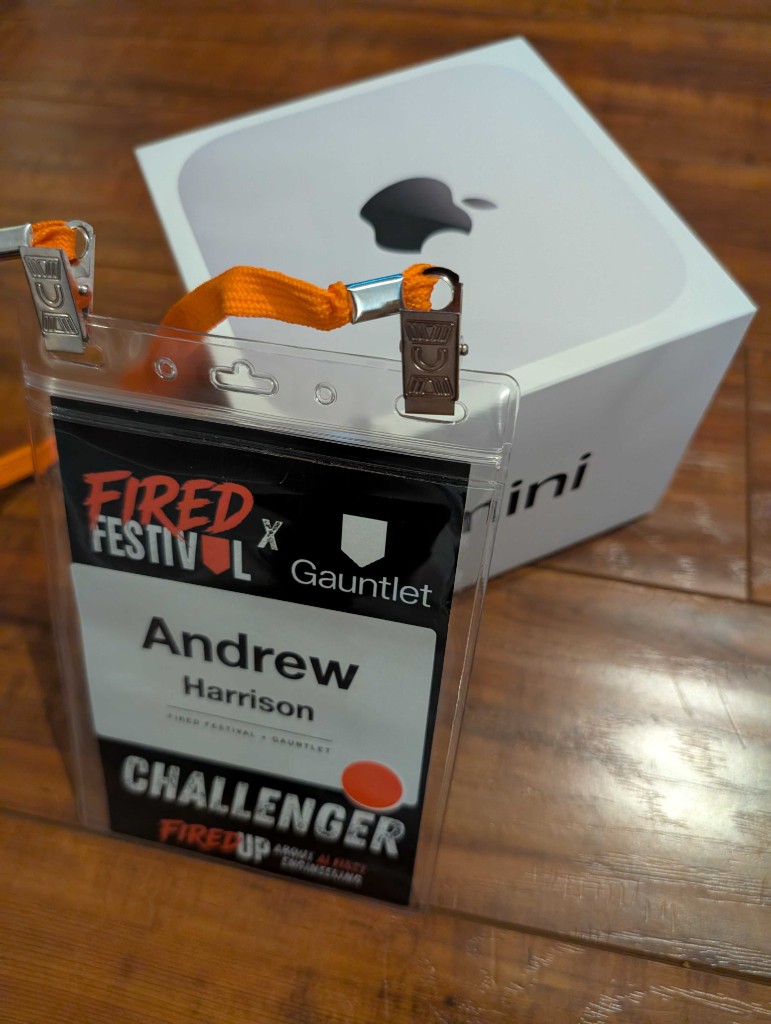
I wasn't sure what I was getting into — I'd never heard of Gauntlet AI before, but their flyer piqued my attention. The software industry is changing faster than ever, and I wanted to know how engineers and companies are staying relevant and keeping up in this high-stakes move to AI.
The 2-day event was advertised as a mix of AI talks interspersed throughout a 24-hour hackathon. Doors opened 7pm Friday with checkin and catered fajitas as 100 of us “Challengers” began to mingle and get our bearings. Our hack focus was announced around 8:30pm: “build an agentic harness”. The guidelines were clear, but the application was wide-open. Your harness could focus on guiding, solving, or researching practically anything.
The first presentation was about “What is an agentic harness?”. Halfway through, I settled on my focus: I'd build something that, regardless of the outcome, would solve a pain-point I currently have: reviewing code.
“I'd build something that, regardless of the outcome, would solve a pain-point I currently have: reviewing code.”
I saw the writing on the wall 9 months ago, when I really started using Cursor and AI-assisted development. The amount of code I was able to produce in such a short amount of time could swamp my team with code review tasks. And once everyone was using it, the problem would compound. Last sprint, there were days when the only thing I accomplished was reviewing a stack of pull requests.
11:30pm Friday evening, the only required deliverable was an architecture document — a one page PDF describing what we would be building. We broke into groups of 4–5 developers, defended our architecture, and let our fellow Challengers poke holes in it, constructively, building each other up and giving each of us the peer feedback greatly needed and appreciated, before we dove in.
I returned 8am Saturday morning, rested and ready. My hack focused on building a harness that could streamline the PR Review process, with lofty goals of multi-agent fanout, a human-in-the-loop curation step, and a self-learning feedback loop, storing history and incorporating context that could be used to feed into the next review.
What I delivered was solid, but ultimately fairly straightforward, and compared to many of the other projects was honestly a bit “boring”. But it worked. There was a moment, about 1pm on Saturday, where I was pushing PRs for the project, and then feeding the PR back into the harness, using this new PR review harness to review the next PR that was building the harness. It was the ultimate dog-fooding moment, and the flywheel I had built was proving itself in realtime.
“It was the ultimate dog-fooding moment, and the flywheel I had built was proving itself in realtime.”
Lunch consisted of a quick salad/sandwich in one hand, while balancing a laptop in the other, screen open, prodding the AI along as I ate. By 3:30pm, I had to be wrapping up features and thinking about how I would demo what I had built. I had one more feature to incorporate (a “quick mode”), and instead of fully building it first, I decided it was a perfect PR to demonstrate the harness.
I fired up Zoom, filmed the demo in one-shot, uploaded the 5 min result to the submission site, and closed the laptop. 4:05pm… Then I opened it back up, spent a few minutes feeding the PR review results back into Cursor, and wrapped up the last feature before the 4:30pm deadline.
They fed us dinner and we mingled as the judges deliberated. The third- and second-place prizes were announced, with very interesting, impressive projects. As for my project, regardless of the result, I knew I was taking home something I could use when Monday rolled around and the PR queue started building up again.
Byron called my name and my jaw dropped. Austen was handed the mic, spoke briefly about what I had built, and then proceeded to describe how the judges had fed their own PRs into the tool, pitting the results against their own AI-assisted reviews, impressed at the quality this tool produced.
I'm not one for spotlights, so I was a bit out of my element as I accepted the prize, shook hands with the event organizers and fellow Challengers, posed for photos, and stepped aside for an interview. The blur of conversations were appreciated, and hope to keep in touch with those I met. Organizers and Challengers alike, Gauntlet AI have put together an incredible community, and I can't wait to see where it carries the industry.
Sooner than I expected, they were shuffling us out the door, and I found myself walking back to the parking garage, a new Mac Mini in my backpack. But more importantly, a new experience under my belt, and new learnings to sit on and incorporate. The software industry is changing fast, and it is up to you to stay ahead of this wave. But maybe it's not so different from any other software phase-shift. The new abstraction is that we can now essentially write software in English, and do it at near the speed of thought.
“The new abstraction is that we can now essentially write software in English, and do it at near the speed of thought.”
What stays constant are the fundamentals. Thoughtful design, clear requirements, and well thought out architecture are going to be even more important, and those who have a solid handle on these fundamentals are going to be just fine.
Acknowledgements
- Byron, Drew, Rebecca, and the rest of the team at Gauntlet AI for organizing such a great event.
- Austen, Matthew, and Vivek, for all your time and effort pouring through our submissions.
- Fellow Challengers, for showing up, buckling down, and helping build this community.
The harness built at Fired Festival
Multi-agent PR review with human-in-the-loop curation, guardrails, and a self-learning feedback loop.
if you made it this far — the access code is “Challenger”, but swap in 3's where it makes sense.